
India appears poised to sustain its growth in a more durable way than before with the economy carrying the momentum from FY23 into the current fiscal year, the Annual Economic Review for 2022-23 released by the finance ministry on Thursday said. However, the report cautioned that escalation of geopolitical stress, enhanced volatility in global financial systems, sharp price correction in global stock markets, a high magnitude of El-Nino impact, and modest trade activity and FDI inflows, are factors that could constrain the pace of growth. "Should these developments deepen and dampen growth in the subsequent quarters, the external sector may challenge India's growth outlook for FY24," the finance ministry said.

Days after Moody's cut its gross domestic product (GDP) forecast for financial year 2022-23 (FY23) after the official GDP print for the June quarter came in lower than expectations, the global ratings agency said it would maintain its long-term sovereign debt credit rating and outlook on Asia's third-largest economy. "The credit profile of India reflects key strengths, including its large and diversified economy with high growth potential, a relatively strong external position, and a stable domestic financing base for government debt," Moody's said on Tuesday. "We do not expect rising challenges to the global economy, including the impact of the Russia-Ukraine military conflict, higher inflation, and the tightening financial conditions on the back of policy tightening, to derail India's ongoing recovery from the pandemic in 2022 and 2023," it said.

Singh emphasised that the Indo-Pacific is no more a maritime construct, but a full-fledged geo-strategic issue, and that the region is facing "a complex web" of security challenges, including boundary disputes and piracy.

The Reserve Bank on Wednesday projected retail inflation to ease to 5.3 per cent in next fiscal from 6.5 per cent this year on assumptions of lower imported inflation, even though core inflation remains sticky. The RBI's inflation outlook for current fiscal has improved from 6.8 per cent projected earlier, to 6.5 per cent, on the back of steeper than expected decline in vegetable prices and Indian basket of crude at $95 a barrel. "Looking ahead, while inflation is expected to moderate in 2023-24, it is likely to rule above the 4 per cent target.

Have the markets already played out their dynamics before the economy has even properly taken off? Are we now destined for a period of mediocre returns despite a strong economy? asks Akash Prakash.

Macroeconomic data announcements, global trends and trading activity of foreign investors would guide momentum in the equity market this week, analysts said. Markets ended a five-week losing streak and gained nearly a per cent last week, helped by a sharp rebound on Friday. Last week, the BSE benchmark jumped 500.65 points or 0.77 per cent and the Nifty gained 169.5 points or 0.87 per cent.

Finance Minister Nirmala Sitharaman on Saturday said the new tax regime will benefit the middle class as it will leave more money in their hands. Talking to reporters after the customary post-Budget address to the central board of the RBI, she said it is not necessary to induce individuals to invest through government schemes but give them an opportunity to make a personal decision regarding investments. "...the way we allowed for standard deduction and also the rates which have been fixed, tax rates which have been fixed for different slabs, it has actually left more money in the hands of the people, the taxpayer, the household," she said.

'For experienced and risk-taking investors, now may be the time to go all in.' 'By 'experienced and risk-taking', I refer to those who remained net buyers in equities during the early stages of the 2020 pandemic.' 'On the other hand, those who exited the markets during the pandemic may go the SIP way.'

The agency welcomed the Rs 1.70-lakh crore package announced by Finance Minister Nirmala Sitharaman earlier in the day but said more measures like loan forbearances for small businesses and households are necessary.

The Chinese savings rate is an astounding 50 per cent of the gross domestic product, the IMF said in its latest world economic outlook.

'If you look at the order books of capital equipment companies or money deployed on the ground, there is forward movement in terms of actual investment by the private sector.'

The simultaneous decline of several trade-related indicators should put policy makers on guard for a sharper slowdown.

'We expect a pick-up in the second half of the current fiscal. But before that, data is likely to show a further slowdown. The second quarter print is likely to be worse than the first quarter,' said a senior official.

India's manufacturing sector activity rose to a 13-month high in December, supported by healthy inflows of new business and strong demand conditions, according to a monthly survey. The seasonally adjusted S&P Global India Manufacturing Purchasing Managers' Index (PMI) stood at 57.8 in December, up from 55.7 in November, as business conditions improved to the greatest extent in over two years. The December PMI data pointed to an improvement in overall operating conditions for the 18th straight month.

The country's gross domestic product (GDP) growth is likely to be 8.8 to 9 per cent in the current financial year, driven by agriculture and industry sectors, Care Ratings said in a report. The country's economy had contracted by 7.3 per cent in fiscal 2020-21. The agency said the outlook for the Indian economy on almost all counts in FY22 would look seemingly better than FY21 on account of the negative base effect.

S&P Global Ratings has upgraded its long-term ratings on Tata Motors to speculative grade 'BB' with stable outlook on earnings improvements and potential deleveraging. The ratings agency had earlier placed Tata Motors in 'BB-'. As per S&P ratings, a BB grade is less vulnerable in the near-term but faces major ongoing uncertainties to adverse business, financial and economic conditions.
International Monetary Fund has cut its 2003 global growth forecast to 3.2 per cent from 3.7 per cent due to the Iraq war and stock market declines, and is particularly worried about weak German growth.

However, the growth during the next financial year would be higher at 8.1 per cent in case of a second wave of the coronavirus and bit slower at 7.9 per cent if the virus recedes and remains under control.

Prospective buyers must make a well-considered decision regarding whether this is the right time to buy a house, particularly with home loan rates at near-peak levels, and the risk of job losses looming in many sectors.

Domestic automobile retail sales rose 10 per cent in June driven by sales growth across various segments, including passenger vehicles and two-wheelers, automobile dealers body FADA said on Thursday. Total retail sales last month rose to 18,63,868 units from 17,01,105 units in the year-ago period. Passenger vehicle retail sales increased 5 per cent to 2,95,299 units as against 2,81,811 units in June 2022.

A lot depends upon the crucial decision-making skills of the management. If you have any doubts about the management then you always have the choice of selling your shares or not buying stocks of those companies at all.

'Given the worries about sluggish growth, rising interest rates and likely volatility, it's quite logical to infer that the SIP route could be the preferred way of investing.'


Retail investment demand for gold bars and coins as well as central bank purchases pushed the global gold demand by 28 per cent to 1,181.5 tonnes in the September quarter, according to the World Gold Council report. The total global demand stood at 921.9 tonnes during the July-September quarter of 2021, the World Gold Council's 'Gold Demand Trends Q3 2022' showed on Tuesday. Investment was down 47 per cent year-on-year as gold backed Exchange Traded Fund (ETF) investors responded to a challenging combination of higher interest rates and a strong US dollar with significant outflows of 227 tonnes.
Economic growth and strong offerings by computer assemblers will drive the demand for personal computers, expected to grow at 18 per cent, in the country in 2003, according to Gartner Dataquest study.

Overall, the credit profiles of players will be supported by healthy balance sheets and liquidity. Prudence in capital and development expenditure, efficient working-capital management, and recent equity raising will help sustain credit metrics in FY22.

Fitch Ratings has revised India's GDP growth estimate to 12.8 per cent for the fiscal year beginning April 1 from its previous estimate of 11 per cent, saying its recovery from the depths of the lockdown-induced recession has been swifter than expected. In its latest Global Economic Outlook (GEO), Fitch said revision is on the back of "a stronger carryover effect, a looser fiscal stance and better virus containment." "India's second half of 2020 rebound also took GDP back above its pre-pandemic level and we have revised up our 2021-2022 forecast to 12.8 per cent from 11.0 per cent," it said. "Nevertheless, we expect the level of Indian GDP to remain well below our pre-pandemic forecast trajectory."

Operating margins have been the primary driver of corporate earnings in India in recent quarters, despite revenue growth suffering from weak consumer demand. Companies across sectors have reported a sharp improvement in earnings before interest, tax, depreciation, and amortisation (Ebitda) margins over the past two years, benefiting from lower commodity and energy prices. Higher margins more than compensated for slower revenue growth, resulting in double-digit growth in net profit for five consecutive quarters.

Moody's Investors Service on Wednesday raised India's economic growth estimate for 2023 to 5.5 per cent from 4.8 per cent pegged earlier, on the back of a sharp increase in capital expenditure in the Budget and a resilient economic momentum. It however revised downwards India's growth estimate for 2022 to 6.8 per cent from 7 per cent pegged in November last year. In its February update to Global Macro Outlook 2023-24, Moody's raised the baseline 2023 real growth projections "meaningfully" for several G20 economies, including the US, Canada, the Euro area, India, Russia, Mexico, and Turkiye, accounting for a stronger end to 2022.

Market participants attribute the stability to the Reserve Bank of India's timely intervention in the foreign exchange market, both in terms of selling and buying dollars.

Reserve Bank of India (RBI) Governor Shaktikanta Das on Thursday said the country's economy has recovered stronger than expected from the initial impact of the COVID-19 pandemic, but there is a need to be watchful of demand sustainability after the end of festivities. Speaking at the annual day event of Foreign Exchange Dealers' Association of India (FEDAI), Das said there are downside risks to growth across the world and also in India. It can be noted that the Indian economy contracted by 23.9 per cent in the first quarter of the fiscal year, and the RBI expects the economy to shrink by 9.5 per cent in FY21.

The services sector growth in India rose to a 13-year high in September on sharp increase in new business amid strong demand conditions, and job numbers continued to increase as overall business mood improved, a monthly survey said on Thursday. The seasonally adjusted S&P Global India Services PMI Business Activity Index rose from 60.1 in August to 61 in September, signalling a sharp upturn in output. In Purchasing Managers' Index (PMI) parlance, a print above 50 means expansion while a score below 50 denotes contraction.

From almost 60 per cent as of December 2019, the share of liquidations in the mode of closure of total Insolvency and Bankruptcy Code (IBC) cases came down to 44 per cent till September 2023, data by the Insolvency and Bankruptcy Board of India (IBBI) shows. Experts say the decreasing trend in liquidations under the IBC in India can be largely attributed to the initial economic conditions of companies entering the Corporate Insolvency Resolution Process (CIRP). IBC experts also say the trend shows a certain stabilisation in IBC with the Code now rid of legacy bankruptcy issues.
'We like certain stocks from banking, insurance, retail, hospitals and capital goods.' 'Though some of these stocks may seem expensive, they will compound well over the long term, thus justifying their current multiples.'
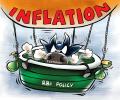
On food inflation, RBI said it is likely to soften from the high levels registered in December and the decline is expected to become more pronounced during the fourth quarter of this fiscal as onion prices ease following arrivals of late kharif and rabi harvests.

The IMF on Tuesday cut India's economic growth forecast by 0.5 percentage points to 9 per cent for the current fiscal year, with its chief economist Gita Gopinath saying that the slight downgrade is mainly due to the impact of the spread of the Omicron variant. "If you look at the 2021-22 fiscal year, we have a slight downgrade of -0.5 percentage points and for the next fiscal year 2022-23 we have a slight upgrade of 0.5 percentage points. So, growth for the previous fiscal year is now nine per cent and for this year now is at nine per cent. We moved it up slightly," Gopinath told reporters during a news conference in Washington. In its latest update of World Economic Outlook on Tuesday, the International Monetary Fund has cut India's economic growth forecast to 9 per cent for the current fiscal year ending March 31, joining a host of agencies which have downgraded their projections on concerns over the impact of the spread of Omicron on business activity and mobility.

From the 30-share Sensex pack, 23 scrips declined in Wednesday's session, led by IndusInd Bank, Bajaj Finance, Tata Motors and Tata Steel which fell by up to 3.87 per cent.

India has been relatively insulated from the severe headwinds in the West. However, with a third of the global economy expected to slip into recession in calendar year 2023, the impact will strongly be felt on India's exports and trade economy, leading economists said in a panel discussion at the Business Standard BFSI Insight Summit in Mumbai on Wednesday. The panel comprised former Reserve Bank of India executive director and former Monetary Policy Committee member Mridul Saggar, State Bank of India Chief Economic Advisor Soumya Kanti Ghosh, Citibank India Chief Economist Samiran Chakraborty, ICRA Chief Economist Aditi Nayar, and IndusInd Bank Chief Economist Gaurav Kapoor. The topic of the panel discussion was No recession in sight: Is India decoupled from developed economies?

India's services sector activity eased in August but growth rates for new orders remain elevated, as services firms indicated the sharpest upturn in new export business which acted as a catalyst for firms to expand their workforces as well as output, a monthly survey said on Tuesday. Despite falling from 62.3 in July to 60.1 in August, the seasonally adjusted S&P Global India Services PMI Business Activity Index indicated one of the strongest increases in output seen since mid-2010. For the 25th straight month, the headline figure was above the neutral 50 threshold.
